WEIWEI PAN

AI Researcher, Educator, Advocate for Technology on Human Terms

About

Weiwei Pan

I am: a researcher who uses multidisciplinary and interdisciplinary lenses to understand the potential harms and benefits of technology; an educator dedicated to bringing underrepresented voices to decision making in technology; an advocate seeking to help shape the way society approaches technology so as to preserve the meaning of human endeavors and the value of human experiences.

Bio

For the past decade at Harvard University, I co-led research in the Data to Actionable Knowledge lab (DtAK), served as the Assistant Director for Graduate Studies in Data Science, taught machine learning and data science at the undergraduate and graduate level, and led initiatives in Equity, Diversity, Inclusion and Belonging.

In the decade prior, I did research in pure math (specifically algebraic topology) and was an Assistant Professor of Mathematics and Computer Science at Saint Mary’s College of California (2009-2015), a liberal arts college with a Lasallian mission of social justice through equal access to higher education. There, I focused on STEM community building, outreach and mentorship for first-generation college students and students from historically minoritized backgrounds.

Training

My formal training is the peculiar product of skipping high school by means of an early-college-entrance program at an historically women’s college (1997-2001), a PhD from a liberal-arts focused research university (2005-2009), a mid-career-change inspired master’s (2015-2017), and post-doctoral tours at young research centers born of old institutions in Germany (2011-2013) and the US (2017-2020).
Research

My research seeks to build assurance frameworks that empower people and societies to retain meaningful control over AI systems, so that these systems strengthen, rather than displace, human judgement, expertise and creativity.

At the model level, I develop validated instruments for observing AI behaviour and bounded controls for changing it. At the task level, I design the human-AI system as a whole, accounting for users who differ, learn, and change while the AI adapts, while maintaining human agency. At the societal level, I work with communities to define legitimate objectives and translate them into technical requirements and tools for governance.

In my research, I use a wide range of formal lenses and methodologies from mathematics, statistics, computer science, machine learning, HCI, and domain science (e.g. policy, psychology, social science, clinical science). My work has spanned a breadth of subfields, including probabilistic and generative modelling, uncertainty quantification, interpretable representations, model steering and controllability, foundation-model evaluation and assurance, robustness and bias auditing, sequential decision-making and reinforcement learning, as well as applied clinical research.

Three nested research levels. The model sits inside the task, and both sit inside society. Each level is paired with its research goal. Hover a ring or a level to highlight it. Assurance Framework for Human-Centered AI (Click to See Research Map) SOCIETY TASK MODEL MODEL Measure AI behaviour and bound the effects of intervention. TASK Adapt to changing users without eroding their agency or expertise. SOCIETY Translate community-defined values into technical and policy requirements.

Teaching

I designed and taught my first course, Advanced C++ Programming, at the age 16, during my junior year at Mary Baldwin College. Since then, I’ve designed and taught over 30 courses in Mathematics, Computer Science, Data Science and Machine Learning across undergraduate and graduate curricula, at six very different institutions of higher learning.

Thirty course entries are positioned along four subject directions and across three nested teaching levels. Hovering over a course mark shows its full title and institution. (Hover for Course Names) Math Computer Science Data + ML Society research advanced foundational

The aim of my teaching is to grow students in intellectual empowerment, independence and agency. A student has truly learned a method when they can explain what question it answers, which assumptions make the answer valid, what evidence supports its use, and, crucially, where it can fail. So, my teaching follows a consistent sequence: motivate a method with a problem that makes it necessary, develop intuition and formalism together, and then ask students to test the method in an open-ended setting.

Three enabling conditions for teaching: structured discovery, visible progress, and equitable access. STRUCTURED DISCOVERY Problems make methods necessary. VISIBLE PROGRESS Goals, support and standards are explicit. EQUITABLE ACCESS Barriers are addressed and identities honoured.

Inclusive education requires more than making the same content available to every student. Students enter the classroom through systems that have already shaped their preparation and sense of themselves as learners. Identity and lived experience are not “personal” factors separate from academic development. They affect who is heard, who receives informal guidance, who feels safe admitting confusion, and who has time to pursue research or unpaid opportunities. As an educator, I hold myself accountable to acknowledge these conditions, address inequities within my control, and honour students’ narratives of their own lives.

Advocacy

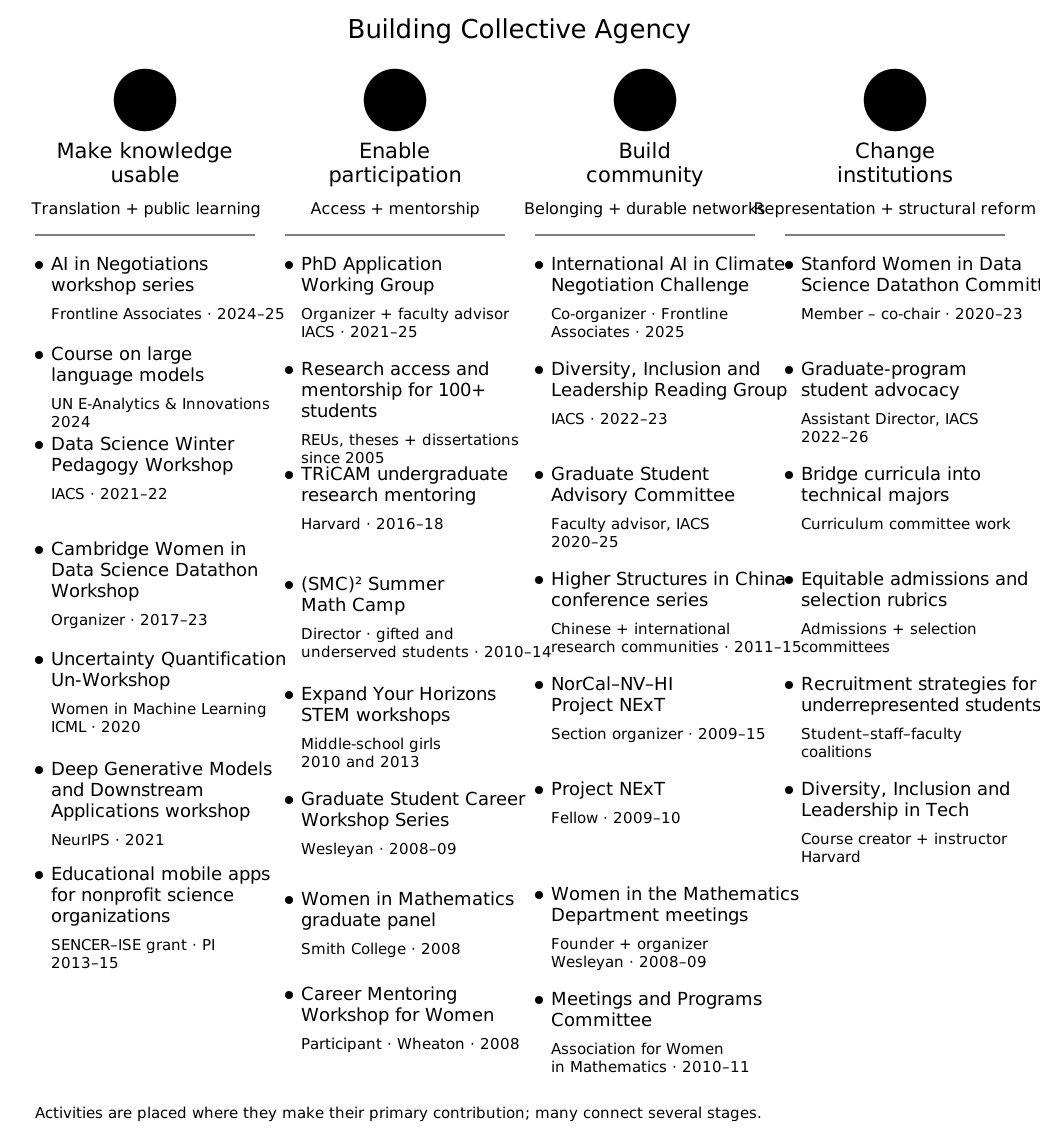
My outreach and advocacy aim to build collective agency. I translate technical knowledge into forms that communities can use, lower barriers to participation through mentorship and access to advanced work, and create durable networks in which people can learn from and support one another. Because individual opportunity is constrained by institutional structures, I also work to affect structural changes (e.g. policy and governance) so that people (especially those with marginalized voices) are empowered to shape the systems that impact them.

Building collective agency: twenty-nine outreach, community-building, diversity, equity, inclusion, and advocacy activities organized along a four-stage pathway — make knowledge usable, enable participation, build community, and change institutions.